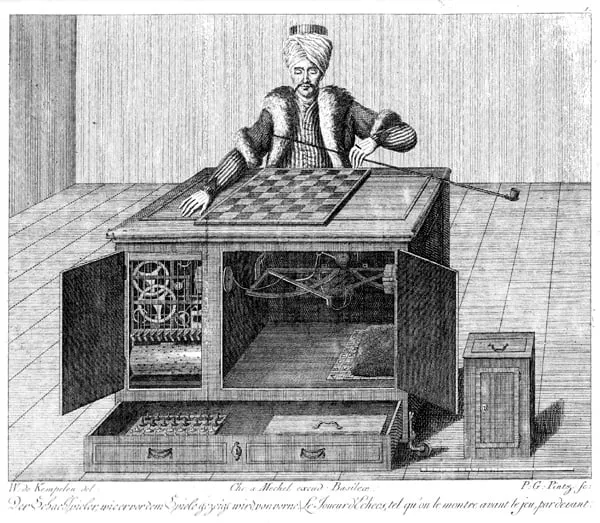
In 1770 the Hungarian inventor Wolfgang von Kempelen unveiled a chess-playing “automaton” for the court of the Empress Maria Theresa: a life-sized figure in Turkish dress seated at a cabinet, which moved its own arm to play - and beat - human opponents. For the better part of seventy years the machine, later acquired and exhibited by Johann Maelzel, toured the courts and theaters of Europe and the United States, drawing crowds who came to watch a machine think. It was the original artificial-intelligence illusion, and it was a fraud: a skilled human chess player was concealed inside the cabinet, working the figure through a system of levers while the operator slid behind the machinery as each compartment was opened for inspection.
The most famous contemporaneous analysis is Edgar Allan Poe’s essay “Maelzel’s Chess-Player,” published in the Southern Literary Messenger in April 1836. Poe had seen the machine exhibited in Richmond and set out to prove, by reasoning rather than by catching anyone in the act, that it could not be a true automaton. His central argument is stated plainly: “It is quite certain that the operations of the Automaton are regulated by mind, and by nothing else.” From the way the machine played - it lost games, it varied its responses, it reacted to its opponent - Poe concluded that “some person is concealed in the box during the whole time of exhibiting the interior.” A pure machine, he argued, would be infallible and consistent in a way the Turk plainly was not.
Poe’s reasoning was sound in conclusion even where his mechanical guesses were off in detail. The Turk did hide a human; over its career the operators included several strong chess players of the day. The deception worked not because the audience was stupid but because the demonstration was carefully staged - doors opened to reveal gears, candles that masked the operator’s own, a narrative of pure mechanism - and because people wanted to believe a machine could play. That combination of stagecraft and willing belief is the recurring shape of AI hype, from this cabinet to chatbots that seem to understand.
The name outlived the hoax. When Amazon launched a service in 2005 for farming out small tasks that computers cannot do to crowds of human workers, it called the service Amazon Mechanical Turk - an open acknowledgment that, then as now, “artificial” intelligence is sometimes a person behind a curtain. The first lesson of the field is older than the field itself: a convincing performance of intelligence is not the same thing as the real thing, and the gap is easiest to hide when the audience is rooting for the machine.