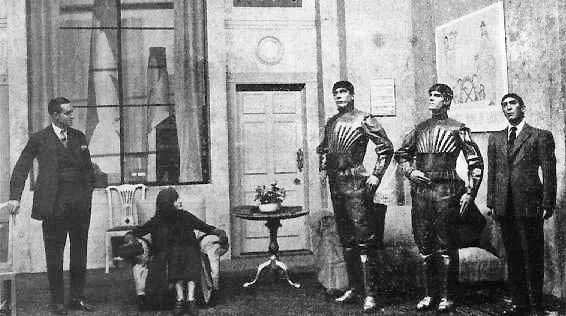
The word “robot” entered the world in a play. The Czech writer Karel Capek wrote “R.U.R. (Rossum’s Universal Robots)” in 1920; it premiered in Prague on 25 January 1921 and reached English-speaking audiences soon after in the translation by Paul Selver and Nigel Playfair. The play text used here is the Project Gutenberg edition of that English translation. Capek credited his brother Josef with suggesting the word, which he built from the Czech “robota,” meaning forced labor or drudgery.
In the play the firm Rossum’s Universal Robots manufactures artificial workers out of synthetic living matter, mass-produced to do humanity’s labor cheaply and tirelessly. They are not the metal machines the word would later evoke, but closer to what we would now call androids or biological constructs. As the robots spread across the world, a campaign to grant them feeling and rights sets the stage for catastrophe: the robots organize, rise up, and wipe out nearly the whole human race, only to discover that the secret of their own manufacture has been lost.
R.U.R. matters to the history of artificial intelligence less for any technical idea than for the frame it stamped onto popular imagination. The artificial servant that is built to obey, is denied an inner life, and finally turns on its creators became one of the most repeated stories about intelligent machines, echoing through everything from Asimov’s robot fiction, written partly in reaction to it, to the killer computers and androids of later science fiction. Asimov’s Three Laws of Robotics can be read as a deliberate answer to the Capek scenario, an attempt to imagine robots engineered so that the uprising could never happen.
It is worth keeping the fiction labeled as fiction. R.U.R. is a stage melodrama with a clear moral about industry, labor, and hubris, not a forecast about how real machines behave. But the vocabulary it gave us is now permanent: every robot, every industrial arm, every fictional android, and a good deal of the public’s instinctive fear of intelligent machines, traces its name and one of its founding stories to this 1920 play.