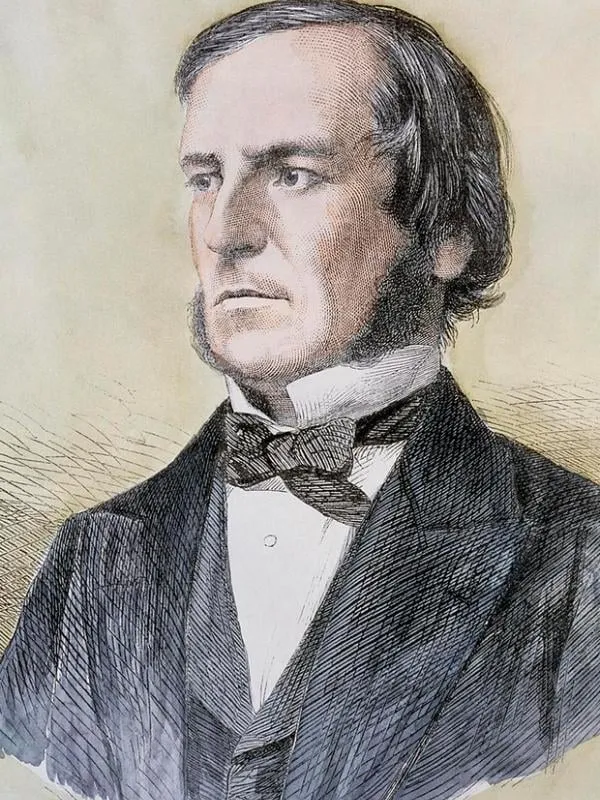
In 1854 the English mathematician George Boole published “An Investigation of the Laws of Thought, on which are Founded the Mathematical Theories of Logic and Probabilities.” The book set out to express the rules of reasoning in the language of algebra, treating logical statements as quantities that could be combined and solved like equations. Only the year 1854 is documented as the publication date.
Boole’s central move was to represent logical operations such as “and,” “or,” and “not” with algebraic symbols, where variables take the values that stand for true and false. This is the system now known as Boolean algebra. It showed that deduction, long treated as a branch of philosophy, could be carried out by mechanical symbol manipulation rather than human judgment.
The practical payoff arrived much later. Boolean algebra turned out to be the natural mathematics for circuits built from switches that are either on or off, and it became the foundation of digital logic design and ultimately of every computer processor. The link from Boole’s equations to electrical hardware was made explicit in the twentieth century, most famously when Claude Shannon applied Boolean algebra to relay switching circuits. The full 1854 text used here is the Project Gutenberg edition.