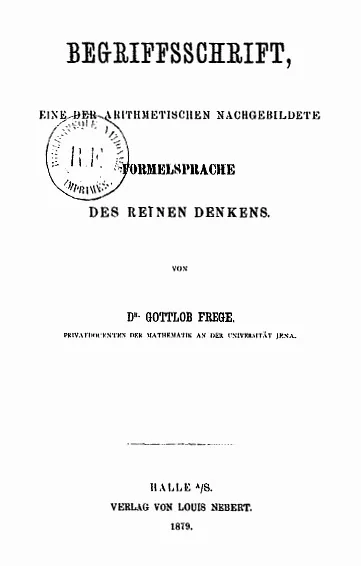
In 1879 the German mathematician and philosopher Gottlob Frege published “Begriffsschrift, eine der arithmetischen nachgebildete Formelsprache des reinen Denkens,” which translates roughly as “Concept Script, a formula language of pure thought modeled on that of arithmetic.” It was a short book, printed in Halle by Louis Nebert. The copy cited here is the scan of the original 1879 German edition held by the Bavarian State Library and hosted at the Internet Archive. Only the year is firmly documented for the publication date.
The Begriffsschrift broke with the centuries-old logic descended from Aristotle and the algebraic logic of Boole and Jevons. Frege built a fully symbolic language in which arguments could be written out and checked step by step with no appeal to intuition. Its central innovation was the system of quantifiers, the notation for “for all” and “there exists” together with bound variables, which let logic express general statements about relations in a way the older term logic could not. This is the predicate logic that every later logician, and every computer scientist, would use.
Frege’s aim was to show that arithmetic could be derived from logic alone, a program later called logicism. That specific goal ran into trouble when Bertrand Russell found a contradiction in Frege’s broader system in 1902, but the logical machinery Frege had created survived intact and became the standard framework for the foundations of mathematics.
The line from the Begriffsschrift to modern computing runs through the questions Frege’s rigor made askable. Once reasoning was reduced to the manipulation of precisely defined symbols according to fixed rules, it became possible to ask whether that manipulation could be carried out mechanically, and which questions it could and could not settle. David Hilbert’s program, Kurt Godel’s incompleteness theorems, and Alan Turing’s 1936 definition of computation all depend on the formal logic that Frege began here.