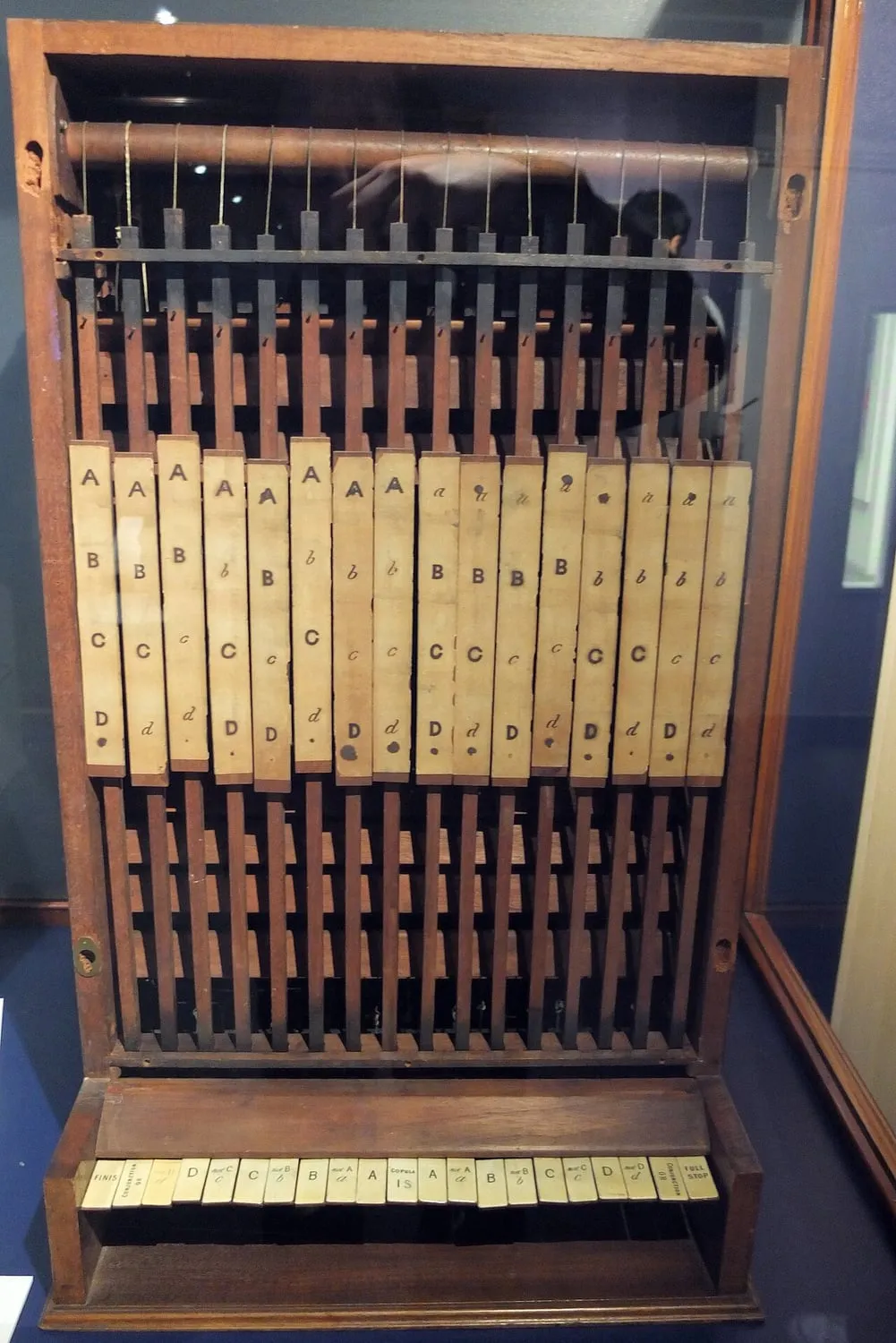
In the late 1860s the English logician and economist William Stanley Jevons designed and built a machine that could carry out logical inference by mechanical means. The device, about the size and shape of a small upright piano and operated by a row of keys, is usually called the Logic Piano or the logical machine. Jevons completed it around 1869 and described it in detail in a paper, “On the Mechanical Performance of Logical Inference,” which he read before the Royal Society on 20 January 1870. The paper appeared in the Philosophical Transactions of the Royal Society of London, volume 160 (1870), pages 497 to 518. The version cited here is the scan of that journal issue hosted at the Internet Archive.
The machine was a physical realization of the logic of classes that George Boole had set out in algebraic form in 1854. An operator entered the premises of a problem by pressing keys standing for terms and logical relations, and the machine’s internal rods and levers eliminated the combinations of terms that the premises ruled out, displaying the consistent conclusions on a board of letters at the front. In effect it performed by mechanism the bookkeeping that a logician would otherwise do by hand on paper.
Jevons’s machine is significant because it was the first device to solve a logic problem faster than a human could without it, turning Boole’s symbolic logic from a notation on the page into the operation of a physical apparatus. It sits in a direct line between Boole’s algebra of thought and the twentieth century insight, made explicit by Claude Shannon and realized in digital hardware, that logical reasoning can be carried out by switching machinery.
The original Logic Piano survives in the collection of the Museum of the History of Science in Oxford. As an isolated invention it had little immediate influence on practical computing, but as a demonstration it made a lasting point: deduction is a kind of calculation, and calculation can be mechanized.