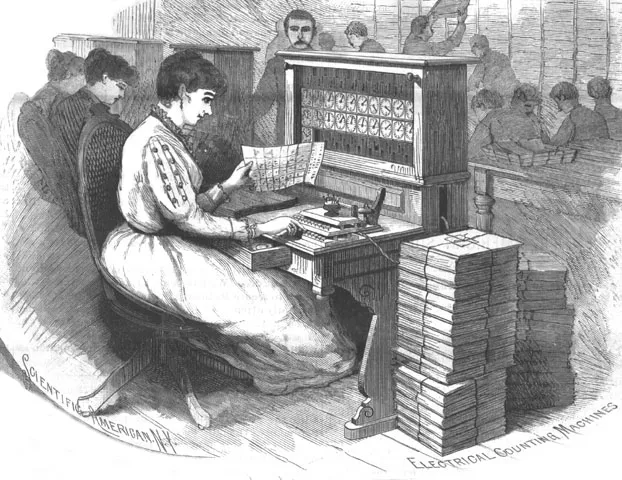
The United States census taken in 1890 was the first to be tabulated by machine. By the 1880 census the volume of data the country was collecting had grown faster than the Census Bureau could count it by hand, and processing the 1880 returns had dragged on for most of the decade. To avoid the same problem again, the Bureau held a competition in 1888 to test faster methods. Herman Hollerith’s electric tabulating system, the subject of his 1889 patents, won decisively. The official account cited here is the U.S. Census Bureau’s own history page on the Hollerith machine.
In the Bureau’s test, Hollerith captured the trial data in 5.5 hours where his nearest rivals needed roughly 44 and 55 hours, and his counting machines were faster still. Census clerks transferred the answers from each person’s questionnaire onto a punched card, marking holes for facts such as age, sex, and race. A reading machine then pressed spring-loaded pins against each card; where a hole let a pin through to a cup of mercury below, an electric circuit advanced a counting dial. An experienced operator could feed about 80 cards a minute, and a sorting box routed cards into bins so that any cross-tabulation could be counted in a further pass.
This was the first time a national administrative task of this scale was handled by automatic machinery rather than by armies of clerks working entirely by hand. The 1890 count covered more than sixty million people, and the machines delivered the basic population totals in months rather than years, while also producing far more detailed cross-tabulations than manual methods had allowed.
The 1890 census is the moment the idea of mechanized data processing proved itself on a real, consequential job. Modified versions of Hollerith’s tabulators stayed in use at the Census Bureau until electronic computers replaced them in the 1950s, and the punched-card method spread from government statistics into business accounting, becoming the backbone of office computing well into the computer age.