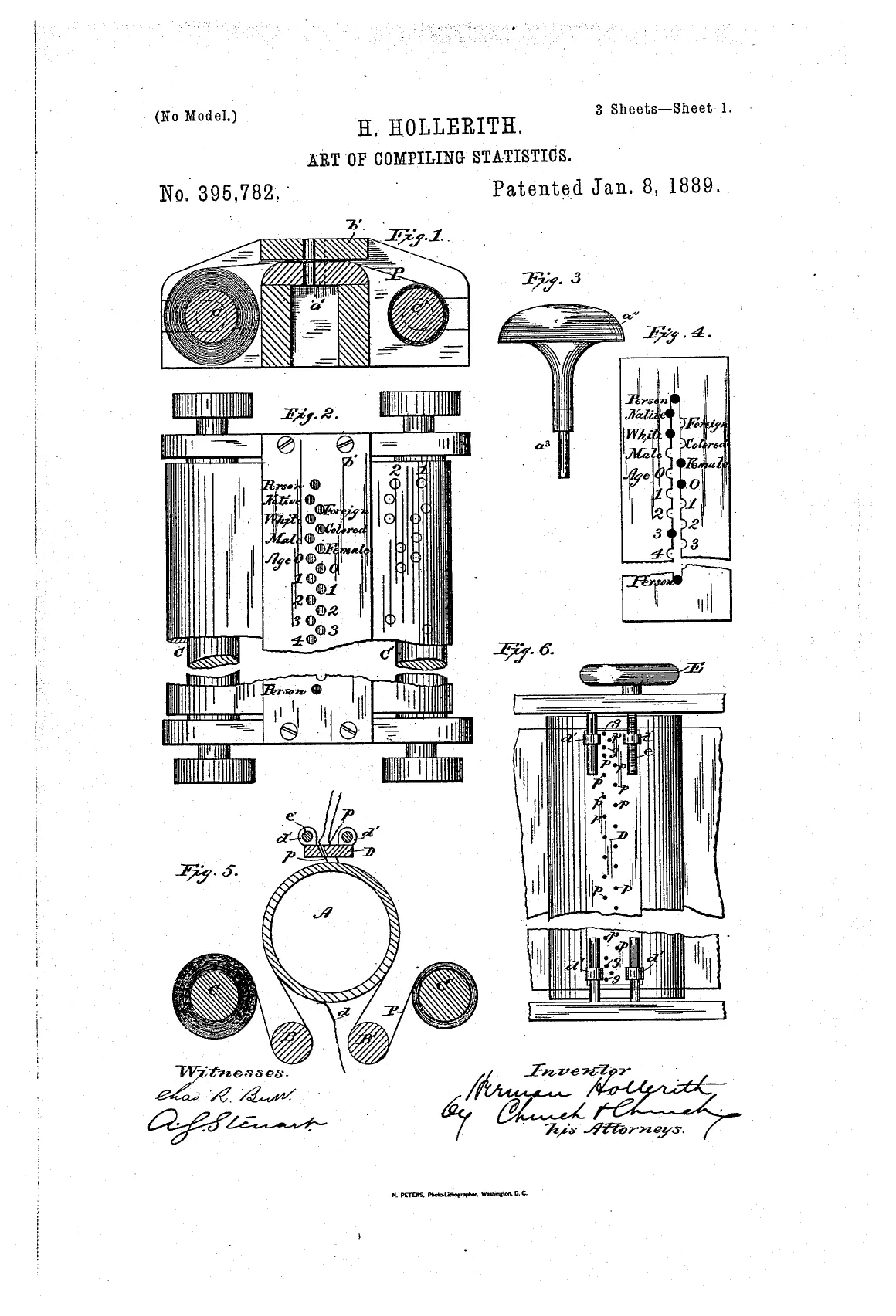
On 8 January 1889 the United States Patent Office granted Herman Hollerith patent number 395,782, titled “Art of Compiling Statistics.” Hollerith had filed the application on 23 September 1884. The patent, together with the companion patent 395,783 for the apparatus granted the same day, set out a system for counting and sorting large bodies of data by machine. The original patent text cited here is served by Google Patents.
The method described holes, or combinations of holes, punched into sheets of electrically non-conducting material, with each hole standing for a fact about a person or thing being counted. A card was placed under a set of spring-loaded pins; wherever a hole had been punched, a pin passed through and dipped into a cup of mercury, completing an electric circuit that advanced a counter dial by one. By choosing which positions to read, an operator could tally any category, and a sorting box could route cards into bins for further counting.
This was a fundamental shift. Earlier calculating engines, from Babbage’s designs to Jevons’s logic machine, operated on numbers or logical terms supplied one problem at a time. Hollerith’s system was built to process a stream of records, the same operation repeated across millions of cards, which is the essence of data processing rather than calculation. The punched card he settled on became a standard medium for storing and feeding data to machines for the better part of a century.
Hollerith founded the Tabulating Machine Company in 1896 to commercialize the system. Through a series of mergers that firm became, in 1924, the International Business Machines Corporation, or IBM. The punched-card tabulator was the commercial and technical ancestor of the office computing industry that IBM would later dominate.