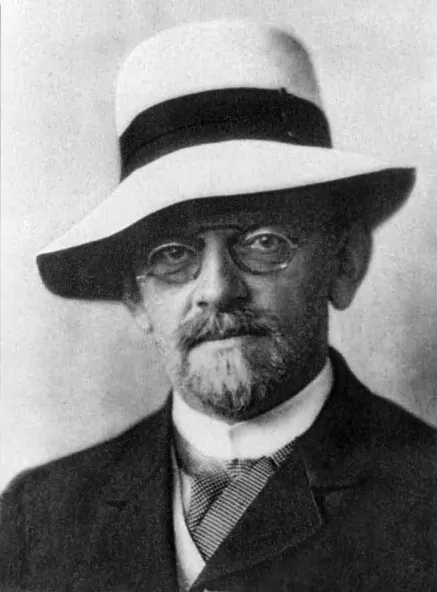
On 8 August 1900 the German mathematician David Hilbert addressed the International Congress of Mathematicians in Paris with a lecture titled “Mathematical Problems.” In it he laid out a set of unsolved problems that he believed would shape mathematics in the coming century. The English translation by Mary Winston Newson was published in the Bulletin of the American Mathematical Society, volume 8 (1902), pages 437 to 479. That translation, hosted by the American Mathematical Society and Project Euclid, is the source cited here.
Hilbert’s list, usually counted as twenty-three problems, ranged across many fields, but the one that matters most for the history of computing is the second. There Hilbert asked for a proof that the axioms of arithmetic are consistent, that is, that they can never lead to a contradiction. He believed mathematics could be placed on a completely secure foundation, with every true statement provable and every question decidable by a fixed method, a confidence captured in his famous declaration that in mathematics there is no “ignorabimus,” no question we are doomed never to answer.
That hope became a research program. To prove arithmetic consistent and decidable, mathematicians had to make precise what a proof and a decision procedure actually were, which pushed them to formalize logic completely in the spirit of Frege’s earlier work. The effort produced the rigorous notion of a formal system and, with it, the means to ask sharp questions about the limits of formal reasoning.
The answers, when they came, were the opposite of what Hilbert had hoped, and they founded computer science in the process. In 1931 Kurt Godel showed that no consistent formal system rich enough for arithmetic can prove its own consistency or settle every statement. In 1936 Alan Turing answered the related decision problem by inventing the abstract machine that defines what computation is, and proving that no general procedure can decide every mathematical question. Hilbert’s second problem is the first link in that chain.